

Most HVAC systems in the UAE are commissioned before the building has permanent power. The chillers are set, the AHUs are balanced, the pumps are proved and the BMS is pointed – all of it running off a temporary diesel generator, through temporary cabling, on a site that is still under construction. It works often enough that the industry treats it as normal. It also produces a steady stream of nuisance trips, failed witness tests, disputed warranty claims and re-mobilisation costs that nobody budgeted for.
The common factor in most of those problems is not the generator and not the chiller. It is the voltage that arrives at the equipment terminals. This article explains what actually happens to voltage on a UAE commissioning site, why a generator AVR does not solve it, and how contracting companies across Dubai, Abu Dhabi, Sharjah, Ajman, Umm Al Quwain, Ras Al Khaimah and Fujairah use servo voltage stabilizers – indoor and outdoor – to protect the plant and get a clean handover.
Key Takeaways
- Generator power can cause voltage fluctuations during HVAC commissioning.
- Voltage dips can lead to VFD trips, motor issues and control failures.
- A generator AVR does not replace a servo voltage stabilizer.
- Servo stabilizers provide stable voltage to HVAC equipment.
- Choose air-cooled or oil-cooled models based on the site and load.
- Proper sizing and installation are important for reliable performance.
- Benoit Technologies provides stabilizer supply, rental, installation and maintenance across the UAE.
Commissioning Is the Most Electrically Hostile Period in a Building’s Life
During normal operation, an HVAC plant sits behind a stiff utility transformer, on permanent cable, with a settled load profile. During commissioning it sits behind none of that. Four things change at once:
- The source is a generator, not the grid. A diesel set has a far higher source impedance than a distribution transformer of the same rating, so every large motor start pulls the voltage down much further.
- The cabling is temporary. Long trailing cables, undersized for convenience rather than for volt drop, add their own losses at exactly the moment inrush current is highest.
- The load is unbalanced and changing hourly. Site accommodation, welding sets, lighting towers, tower cranes and single-phase tools sit on the same temporary board as the plant being commissioned.
- Equipment is started and stopped repeatedly. A chiller that would start twice a day in service may be started twenty times in a commissioning week, each start another transient.
ISO 8528-5, the standard that defines generating set performance classes, puts numbers on this. A class G2 set is permitted a steady-state voltage deviation of +/-2.5%, and the transient limits in the standard allow voltage dips in the region of -20% on load acceptance, with recovery inside one second. Even the tightest commonly specified class, G3, permits a transient dip of up to -15%. Those are the permitted values for a healthy, correctly sized set. A set that was sized on connected kW rather than starting kVA, or one that is lightly loaded and hunting, will do worse.
A 15% to 25% dip lasting a few hundred milliseconds is invisible to a site electrician with a handheld meter. It is not invisible to the plant.
What Voltage Deviation Actually Does to HVAC Equipment
Motors lose torque as the square of the voltage
Induction motor torque falls with the square of applied voltage. A 10% undervoltage leaves roughly 81% of rated torque – about a 19% loss – while the motor draws more current to deliver the same shaft power, and runs hotter for it. IEC 60034-1 defines Zone A as +/-5% voltage and +/-2% frequency, within which a motor must deliver its rated output. Zone B extends to +/-10% but is explicitly not intended for continuous operation, and the standard notes the higher temperature rise that comes with it. A chiller compressor motor being proved on a supply that wanders across Zone B is being loaded outside the conditions its performance data was written for.
VFDs trip on DC bus undervoltage
Variable frequency drives on chilled water pumps, condenser water pumps and AHU fans monitor their DC bus. A short, deep dip discharges the bus faster than the drive can ride through, and the drive trips on undervoltage. On a commissioning site this reads as an intermittent, unrepeatable fault, and hours are lost chasing a drive that is working exactly as designed.
Contactors and control circuits drop out before anything else does
AC contactor coils are typically specified to operate reliably between 85% and 110% of rated coil voltage. Below that band they chatter or release. A dip that a motor would survive can drop out a starter contactor, an interlock or a safety relay, which then takes the sequence down with it – and in a package unit, the restart lockout timer adds another delay before anyone can even retry.
Controls, BMS and instrumentation see it too
BMS controllers, field panels, flow meters, pressure transmitters and the drive HMIs all sit on small switch-mode supplies. Repeated brownouts shorten the life of those supplies and corrupt the very readings the commissioning team is trying to record.
There is a commercial consequence as well as a technical one. Equipment manufacturers write their warranty and their performance data against a supply within a stated tolerance. If witnessed performance testing is carried out on a supply that was demonstrably outside that band, the results are open to challenge by the consultant, and any subsequent compressor or drive failure is open to challenge by the vendor. For a main contractor, one rejected witness test on a chiller plant costs more than the stabilizer that would have prevented it.
Why the Generator AVR Is Not a Substitute for a Stabilizer
This is the objection that comes up on every site: the generator already has an automatic voltage regulator, so why add another box?
Because they do different jobs, at different points in the system.
Table 1: Generator AVR compared with a servo voltage stabilizer
| Generator AVR | Servo voltage stabilizer |
What it controls | The alternator excitation field | The voltage delivered to the load |
Where it senses | At the alternator terminals | At the stabilizer output, downstream of the cabling |
Volt drop in temporary cable | Not corrected – it is downstream of the sensing point | Corrected, because correction happens at the load end |
Phase imbalance | Regulates on one phase or an average of three | Three independent variacs and buck-boost transformers correct each phase separately |
Utility supply once energised | Does nothing – the AVR only exists while the set runs | Continues to regulate on utility supply |
Typical steady-state band | +/-0.5% to +/-5% depending on ISO 8528-5 class | +/-0.25% to +/-2% at the output, depending on model |
The point about phase imbalance matters more than contractors expect. A temporary board carrying site accommodation, lighting and welding on top of the HVAC plant is never balanced. An AVR cannot fix an imbalance it is not sensing. A three-phase servo stabilizer built for unbalanced loads – which is how the POWERON ENERTECH ESCVS and PSCVS units are specified – regulates each phase on its own, so the plant sees a balanced 400 V regardless of what the rest of the site is doing.
The other practical argument is that the stabilizer stays useful after commissioning ends. The generator leaves site. The stabilizer stays in the substation or plant room and goes on regulating the utility supply for the life of the building. DEWA‘s own guidelines for major projects reference EN 50160 for the characteristics of the supply voltage at the customer’s terminals; that standard allows the supply to vary across a band which, while perfectly compliant, is wider than what sensitive plant is happiest with.
How a Servo Voltage Stabilizer Works
A servo voltage stabilizer is a closed-loop electromechanical regulator. The control circuit continuously measures the output voltage and compares it with the set point. When it detects a deviation, a servo motor drives the wiper of a variable transformer (variac or dimmer), which changes the input to a buck-boost transformer connected in series with the supply. The buck-boost winding then adds or subtracts the exact voltage needed to bring the output back to nominal. Because the correction is made by a series transformer rather than by switching the load, the output stays a clean sinusoid – the datasheets state waveform distortion as nil and the duty cycle as 100% continuous sinusoidal.
Two numbers describe how well it does this: the input window it can accept, and how fast it corrects.
Table 2: Regulation performance from the POWERON ENERTECH datasheets
Model / series | Input range | Output regulation | Correction speed | Response time |
ESCVS 150 / 200 kVA, air cooled | 360-460 V | 400 V AC +/-2% | 35 V/s (Ph-N), 70 V/s, 110 V/s (Ph-Ph) | Above 10 ms |
ESCVS 100 / 125 / 150 kVA, oil cooled | 340-460 V | 400 V AC +/-1% | 35 / 70 / 110 V/s | 10 ms |
ESCVS 250 kVA, forced air tower | 340-460 V | 400 V AC +/-1% | 7 V/s | 10 ms |
Servo Prime, 20-60 kVA | 340-460 V (215-415 V optional) | 400 V AC +/-1% | Microprocessor controlled servo motor | – |
Servo Fusion / Immunity / Shield, 80-500 kVA | 340-460 V (215-415 V optional) | 400 V AC +/-0.25% | Microprocessor controlled servo motor | – |
PSCVS 400-800 kVA, oil cooled | 350-460 V (400 kVA: 360-440 V) | 400 V +/-1% | 26 V/s | – |
PSCVS 1000 kVA, oil cooled | 400 V +/-20% | 415 V +/-2 to 5% | 26 V/s | – |
Read that table against the generator behaviour described earlier and the case makes itself. A set drifting between 360 V and 440 V on a loaded, unbalanced temporary board is delivering roughly 400 V +/-10% to the plant. The stabilizer takes the same input and hands the chiller 400 V within 1% – or within 0.25% on the Fusion, Immunity and Shield series.
The PSCVS oil cooled datasheets state DG compatibility as complied, which is the specific point contractors should look for when the source is a generator rather than the grid.
Indoor or Outdoor? Specifying for UAE Site Conditions
This is where a lot of site decisions go wrong, and it is worth being precise. Indoor and outdoor are not interchangeable, and an IP 20 or IP 22 enclosure is not weatherproof. Putting an indoor unit outside under a tarpaulin or a scaffold sheet is one of the most common – and most expensive – mistakes made on UAE commissioning sites.
Indoor units – air cooled
- Natural convection or forced air cooled, in a powder coated MS enclosure, floor mounted on castors so it can be moved between areas as commissioning progresses.
- Degree of protection IP 20 to IP 22 – dust and finger protection only. Substation, plant room, electrical room or a properly ventilated site cabin.
- Ambient capability on the air cooled ESCVS datasheets is up to 55 degrees C with relative humidity up to 90%. The Prime, Fusion, Immunity and Shield series are rated -10 to +50 degrees C, relative humidity below 90%, altitude below 1500 m.
- Remember that the losses become heat in that room. At 98.5% efficiency a 200 kVA unit still rejects a few kW into the space, so the room needs ventilation – a point frequently missed when a stabilizer is squeezed into a small temporary switchroom.
- Practical range for HVAC commissioning: 20 kVA to 500 kVA.
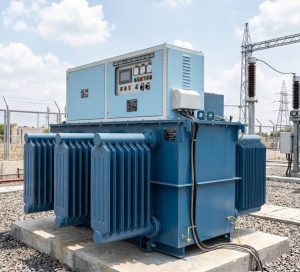
Outdoor units – oil cooled with canopy
- The active parts sit in a transformer oil filled tank with welded radiators – 750 litres on the PSCVS 400 to 800 kVA units, approximately 1300 litres on the PSCVS 1000 kVA, to IS 335 transformer oil.
- Oil provides both cooling and dielectric strength, which is why the large ratings are built this way. The datasheets quote a dielectric strength of 1.5 kV RMS for one minute.
- The POWERON ENERTECH oil cooled ESCVS datasheet offers the unit as an outdoor unit complete with canopy. The canopy – not the IP rating of a standard indoor enclosure – is what makes the installation genuinely outdoor rated.
- Ambient capability on the PSCVS oil cooled datasheets is 0 to 50 degrees C with relative humidity up to 95%, which is the right envelope for a UAE summer with the unit sitting beside the generator on a hardstand.
- Specify the paint and canopy properly for coastal sites. Salt laden air in Ajman, Umm Al Quwain, Fujairah, Ras Al Khaimah and the coastal strip of Abu Dhabi will find any weakness in the finish within a season.
As a rule of thumb for UAE projects: below about 300 kVA and with a room available, use an indoor air cooled unit. Above 400 kVA, or where there is no room and the stabilizer has to live next to the temporary generator, use an oil cooled unit with a canopy.
The Range Available in the UAE
Benoit Technologies supplies servo voltage stabilizers from 10 kVA to 3000 kVA across the UAE. The tables below list the POWERON ENERTECH models most often specified for HVAC and building services work, taken directly from the manufacturer’s datasheets.
Table 3: Indoor air cooled servo voltage stabilizers
Series / model | Rating (kVA) | Cooling | Output accuracy | Efficiency | W x D x H (mm) |
Servo Prime, ESVS-3-340-460 | 20 / 30 / 40 / 60 | Natural convection, no fan | +/-1% | 3 phase >96% | 350 x 650 x 1150 |
Servo Fusion, ESVS-3-340-460 | 80 / 100 / 150 | Forced air | +/-0.25% | >99% at nominal input | 550 x 750 x 1300 |
Servo Immunity, ESVS-3-340-460 | 200 / 250 / 300 / 350 | Forced air | +/-0.25% | >99% at nominal input | 700 x 1150 x 1700 |
Servo Shield, ESVS-3-340-460 | 400 / 450 / 500 | Forced air | +/-0.25% | >99% at nominal input | 800 x 1150 x 1800 |
ESCVS 150 kVA air cooled | 150 | Natural air | +/-2% | >98.5% at full load | 750 x 930 x 1620 (400 kg) |
ESCVS 200 kVA air cooled | 200 | Natural air | +/-2% | >98.5% at full load | 750 x 930 x 1620 (500 kg) |
ESCVS 250 kVA tower | 250 | Forced air | +/-1% | Up to 98.5% at full load | IP 20 indoor unit |
Table 4: Oil cooled servo voltage stabilizers for outdoor and high capacity use
Model | Rating | Input range | Output | Rated current | Oil quantity | Weight |
ESCVS 100 / 125 / 150 kVA | 100-150 kVA | 340-460 V | 400 V +/-1% | – | Oil cooled, outdoor canopy option | – |
PSCVS 400 kVA | 400 kVA | 360-440 V | 400 V +/-1% | 456 A | approx. 750 L (IS 335) | approx. 1200 kg |
PSCVS 500 kVA | 500 kVA | 350-460 V | 400 V +/-1% | 456 A | approx. 750 L (IS 335) | approx. 1200 kg |
PSCVS 600 kVA | 600 kVA | 350-460 V | 400 V +/-1% | 456 A | approx. 750 L (IS 335) | approx. 1200 kg |
PSCVS 800 kVA | 800 kVA | 350-460 V | 400 V +/-1% | 970 A | approx. 750 L (IS 335) | approx. 2500 kg |
PSCVS 1000 kVA | 1000 kVA | 400 V +/-20% | 415 V +/-2 to 5% | 1150 A | approx. 1300 L (IS 335) | approx. 2500 kg |
All of the above are three-phase, rated for unbalanced loads, with a manual bypass switch, input protection and microprocessor based control. Protection on the ESCVS air cooled units covers under voltage and over voltage tripping, short circuit, phase reversal and single phasing. The PSCVS units use an L&T or Schneider MCCB at the output, with an ACB and an input bypass switch on the 1000 kVA. Declared standards are IS 9816-1994 for the ESCVS air cooled units and IS 9815 for the PSCVS oil cooled units; the Prime, Fusion, Immunity and Shield series are declared to IEC 61558 for transformer safety, EN 61000-6-2:2006 and EN 61000-6-3:2007 for electromagnetic compatibility, and IEC 60529 for degree of protection.
Sizing a Stabilizer for an HVAC Commissioning Set-Up
Sizing is where most enquiries need the most help, so here is the method rather than a rule of thumb:
- Work in kVA, not kW. Add up the connected kVA on the temporary board that the stabilizer will feed – chillers, pumps, AHUs, FCU circuits, controls and the small power that shares the board.
- Add the starting contribution of the largest motor. A direct-on-line start draws several times full load current; even with a soft starter or VFD the inrush is significant. The stabilizer has to hold voltage through it, not just after it.
- Leave headroom. Select so that the continuous load sits at or below about 80% of the stabilizer rating. This protects against the site load growing during commissioning, which it always does.
- Check the input window against the worst case, not the nominal. If the generator is expected to sag to 350 V under a chiller start, a unit with a 360-460 V window will drop out at exactly the wrong moment. The 340-460 V and 400 V +/-20% models exist for this reason.
- Confirm the overload rating. The ESCVS air cooled units are rated 120% for 15 minutes; the Prime, Fusion, Immunity and Shield series operate at 100-125% load for one minute and above 125% for 10 seconds. Match this to the starting profile.
- Specify the bypass. A manual bypass switch lets the plant keep running if the stabilizer needs attention – essential on a commissioning programme with no float.
- Confirm unbalanced load capability. All units listed above are unbalanced type, which is what a temporary site board requires.
If the connected load is not yet firm – which is usual at tender stage – send us the temporary distribution single line and the chiller schedule and our engineers will size it against the actual starting currents.
Installation and Site Practice
- Position the unit as close as practical to the load board. Every metre of temporary cable downstream of the stabilizer is volt drop the stabilizer cannot correct.
- Leave the ventilation clearance the manufacturer requires, and do not stack material against a forced air unit. On an active construction site this needs a barrier and a sign, not good intentions.
- Earth to the stud provided in the enclosure. The ESCVS datasheets specify an earthing stud provision – use it, and prove continuity before energising.
- Use the cable glands and the copper busbar terminations supplied. The PSCVS units are built with space at the rear for input and output cables; plan the trench or tray route before the unit lands.
- On oil cooled units, check the oil level and let the unit stand after transport before energising.
- Prove the bypass before you need it. Operate the changeover once, with the load off, and confirm the sequence with the site team.
- Record input and output voltage from the on-board LCD at each commissioning stage. That record is what settles a dispute later about whether the plant was tested within tolerance – and it takes thirty seconds.
Maintenance
A servo stabilizer is electromechanical, so it has a small number of wearing parts and a long service life. Periodic attention should cover the variac carbon roller or brush contact surface, the servo motor drive, terminal tightness at input and output, the condition of the contactor and MCCB, and cleaning of the ventilation path on air cooled units. On oil cooled units the transformer oil should be checked and dielectric tested at the recommended interval. The POWERON ENERTECH datasheets describe the system as maintained once in five years, which is realistic for a clean indoor installation – a unit that has lived on a dusty construction site through a UAE summer deserves to be looked at more often than that.
Benoit Technologies provides annual maintenance contracts covering stabilizers alongside UPS systems, generators, central battery systems and precision cooling units, so a single AMC can cover the whole critical power chain in a building.
Across the Seven Emirates
The engineering is the same everywhere in the country; the practicalities differ. Projects in Dubai and Abu Dhabi tend to be large enough that the stabilizer is specified at design stage and lands in a dedicated substation or plant room, which favours indoor air cooled units in the 200-500 kVA band. Industrial work in Sharjah, Ajman and the Ras Al Khaimah industrial zones more often needs the stabilizer outdoors beside the temporary generator, which points to an oil cooled unit with a canopy. Coastal sites in Fujairah, Umm Al Quwain and Ajman need the outdoor enclosure and finish specified with salt in mind. Remote or early-stage sites anywhere in the country, where permanent supply is months away, are the clearest case of all for a stabilizer between the generator and the plant.
Benoit Technologies supplies, installs, commissions and maintains voltage stabilizers throughout the UAE, and supports projects in Oman, Qatar, Saudi Arabia and Bahrain from the same base.
Why Contracting Companies Work With Benoit Technologies
Benoit Technologies LLC supplies critical power equipment across the UAE and the wider GCC – UPS systems, batteries, voltage stabilizers, isolation transformers, precision cooling, ATS and bypass panels, EV charging and solar. For HVAC and building services contractors, that breadth matters: the stabilizer, the UPS feeding the BMS, the precision cooling in the server room and the AMC that covers all of it can come from one supplier with one point of technical contact.
Our team works from the temporary distribution single line and the actual equipment schedule rather than from a rule of thumb, which is the difference between a stabilizer that solves the problem and one that simply sits in the circuit. We also carry out power quality analysis and load bank testing, so where the cause of a site problem is not yet clear, it can be measured before anything is bought.
Get a Stabilizer Specified for Your Site
If you are commissioning HVAC plant on generator power anywhere in the UAE – Dubai, Abu Dhabi, Sharjah, Ajman, Umm Al Quwain, Ras Al Khaimah or Fujairah – and you are seeing nuisance trips, drive faults or a supply you are not confident presenting at a witness test, talk to us before the next test date. Send the temporary distribution single line, the chiller and pump schedule and the required-on-site date, and our engineers will come back with a sized recommendation – indoor or outdoor, air cooled or oil cooled – for supply, rental, installation, commissioning and ongoing maintenance.
Benoit Technologies LLC – Voltage stabilizers from 10 kVA to 3000 kVA, supplied and supported across the UAE. Visit www.btlme.com or contact our technical team for a site-specific recommendation.