

Table of Contents
A hospital power supply system in the UAE needs to do one thing without fail: keep vital equipment running when a fault occurs, not just when everything’s working fine. A hospital power supply system uses medical isolated power supplies, insulation monitoring devices, isolating transformers, and UPS systems to maintain electrical continuity in critical care areas such as operating theatres and ICUs, even if a first electrical fault occurs.
Why Hospitals Cannot Rely on a Standard Power Supply
In a normal building, a faulty circuit trips the breaker and the power cuts off. Fine for an office. Not fine for an operating theatre, an ICU, or a dialysis unit, where losing power mid-procedure puts a patient at real risk.
There is no single national database tracking exactly how often this happens inside operating rooms, but published case reports point to two causes that keep coming up again and again: backup generators failing to kick in during a wider grid outage, and construction or maintenance work that exposes a fault sitting in a hospital’s existing wiring.
This is why medical locations, operating theatres and intensive care areas especially, sit under a different set of rules entirely. They are classed as Group 2 premises under IEC 60364-7-710, which covers operating theatres, operation preparation and plaster rooms, recovery rooms, intensive care units, heart catheterisation rooms, angiography rooms, premature baby units, and any space where life-support equipment is connected directly to a patient. In plain terms, if a first fault happens on the line, the supply is designed to keep running instead of cutting out, buying staff time to respond safely rather than reacting in the dark.
What Actually Goes Into a Medical Isolated Power Supply
A medical IPS isn’t one device. It’s a small set of parts, working together, each covering a different job.
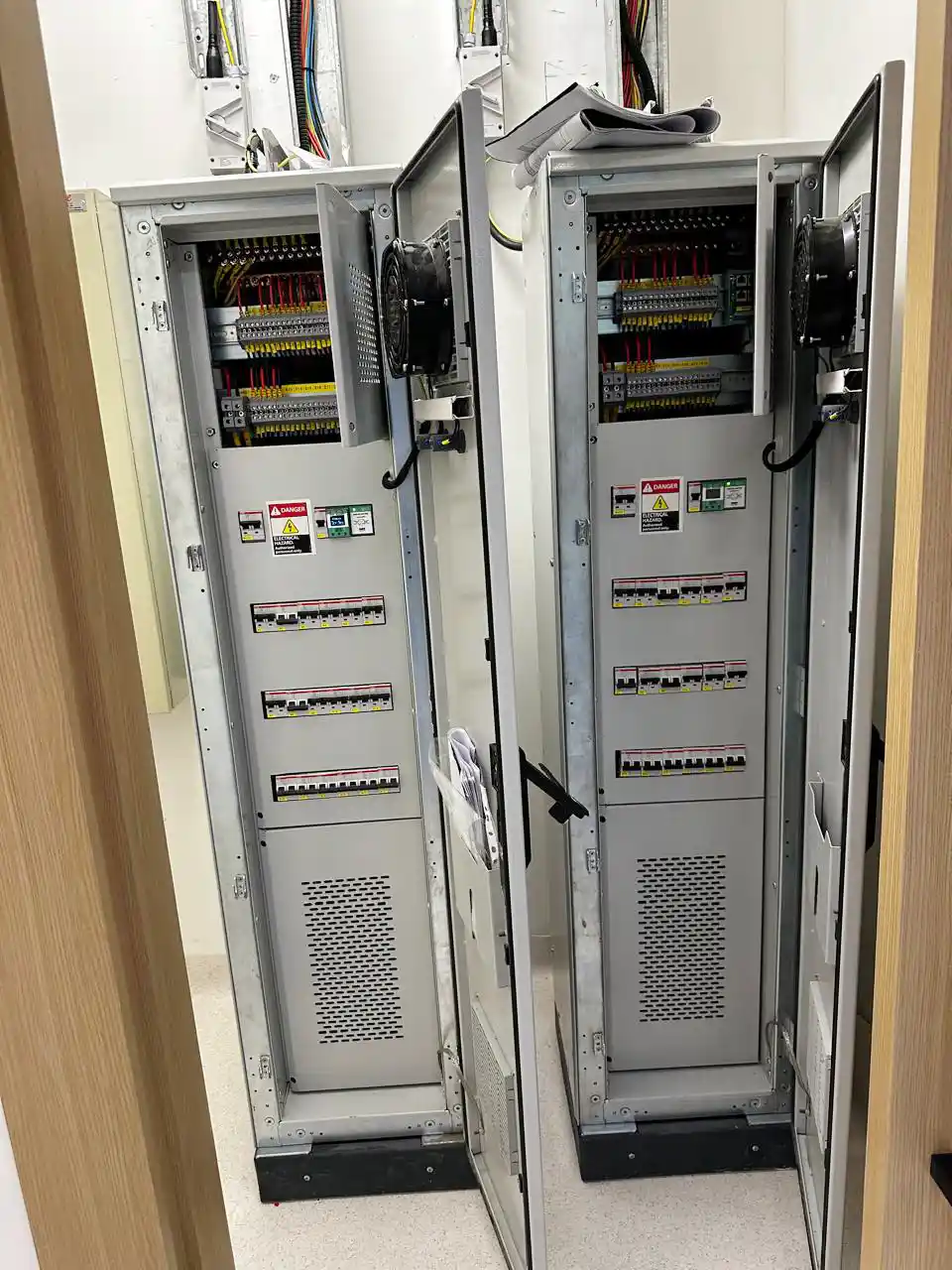
The isolating transformer separates the medical circuit from the general earth reference, so a first fault doesn’t trigger an automatic shutdown. These transformers typically come in 5 kVA, 8 kVA, and 10 kVA ratings, built with double-wound copper construction and Class H insulation, and sized against the connected load rather than guessed at. Under IEC 61558-2-15, the standard covering isolating transformers for medical supply, leakage current from the transformer to earth shouldn’t exceed 0.5 mA under normal, unloaded conditions. That is a genuinely tight tolerance, and it’s there for good reason given what’s often plugged into these circuits.
The insulation monitoring device, or IMD, watches insulation resistance continuously, reading it across a range from 1 kΩ up to 10 MΩ. The alarm threshold is adjustable, usually somewhere between 50 kΩ and 500 kΩ depending on the hospital’s own protocol, with 50 kΩ being the typical starting point. When resistance drops below that line, the device raises an alarm within about a second, without cutting the power supply itself.
A fault location system narrows the search further. Rather than an engineer testing circuit after circuit by hand, an independent locator can scan up to twelve outgoing circuits, cycling through each one roughly every 20 seconds, and flag which specific feeder has the problem.
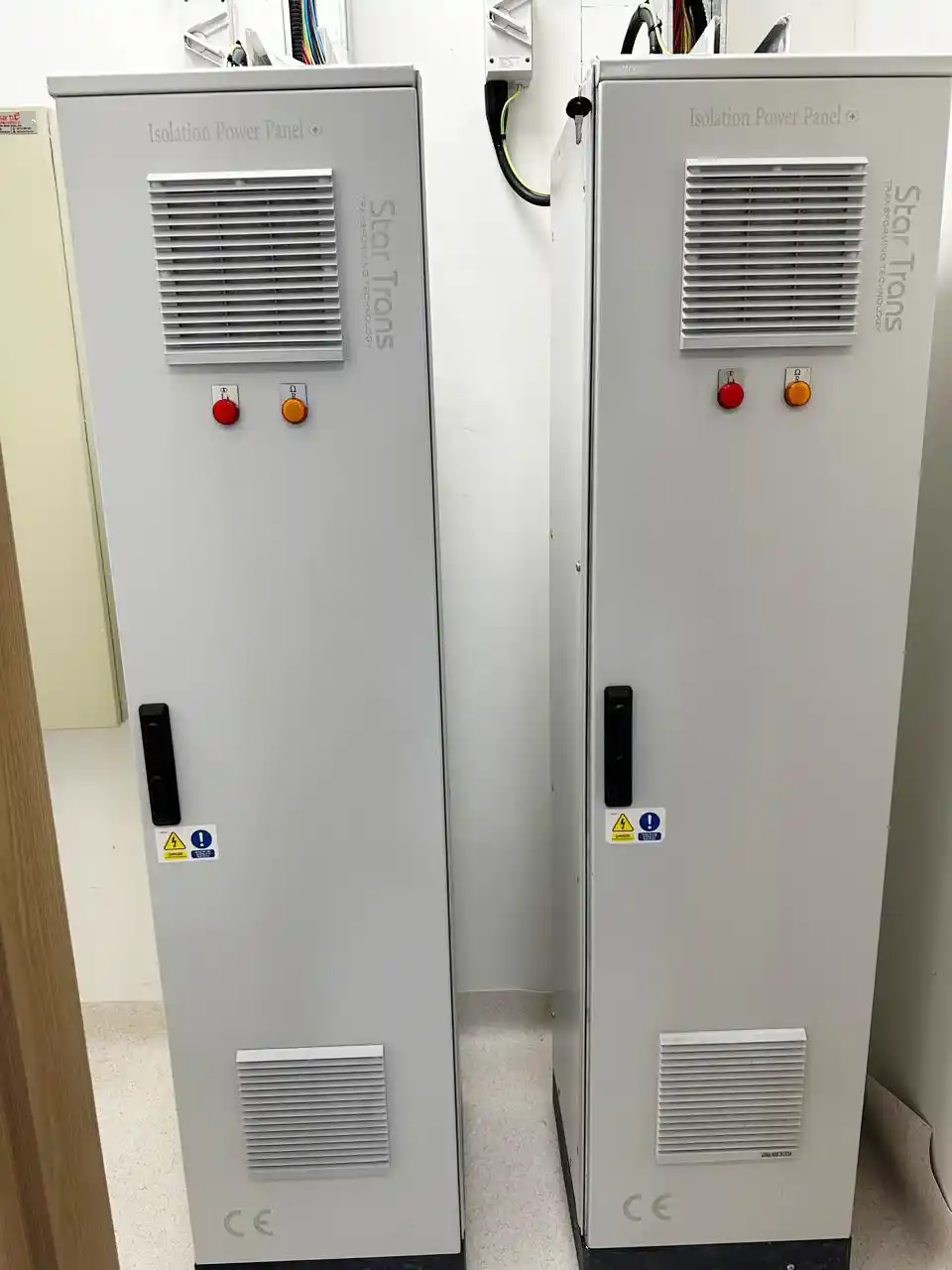
A remote alarm panel puts all of this in front of staff. A simple traffic-light system does the job well: green means everything’s fine, orange means insulation resistance has slipped below the set threshold, and red flags a genuine fault, whether that’s transformer overload, overheating, or another monitored issue.
None of these parts do much good sitting on their own. They are specified as a set, and that’s the approach we take at BTLME when we are putting a system together for a hospital wing or a standalone theatre.
Standard Power Supply vs Medical Isolated Power Supply
Feature | Standard Power Supply | Medical Isolated Power Supply |
Response to first fault | Circuit trips, power cuts immediately | Supply continues, alarm raised instead |
Earthing arrangement | Conventional TNS earthing | Isolated medical IT earthing |
Monitoring | Reactive, after a fault trips the breaker | Continuous insulation resistance monitoring |
Fault location | Manual testing, circuit by circuit | Automatic fault location |
Typical use | Offices, corridors, admin areas | Operating theatres, ICUs, catheter labs |
Governing standard | General wiring regulations | IEC 60364-7-710 for Group 2 locations |
Operating Theatre Power Supply Dubai
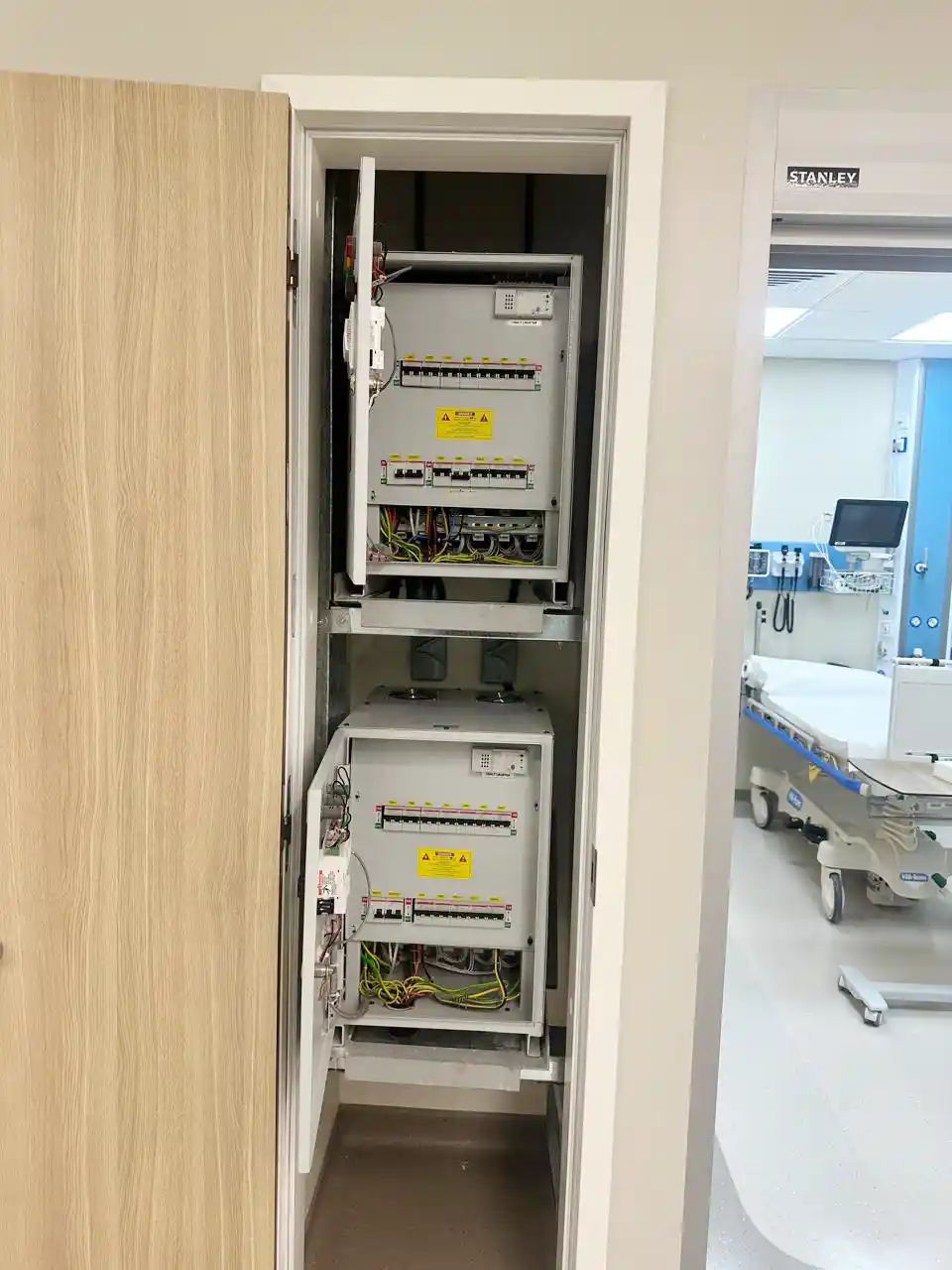
Not every corner of a hospital needs this level of protection. A waiting room runs fine on ordinary power. But an operating theatre power supply Dubai project has to account for the fact that one interruption mid-surgery isn’t an inconvenience, it’s a hazard with real consequences.
Theatre power design usually brings together a few specific elements:
- Redundant supply paths – two independent routes feeding the same circuit, so a fault on one leaves the room fully lit and running on the other
- Fast transfer switching – switching between main and backup supply within a fraction of a second, quick enough that connected monitors barely register the change
- Upstream breaker protection – an incoming breaker rated above 63 A with a Type-D tripping curve, chosen specifically to avoid nuisance tripping caused by the transformer’s own inrush current at start-up
- Distribution sized to the room – outgoing circuits typically rated at 16 A each, with no more than three socket outlets protected per breaker, keeping any single fault contained to a small section rather than the whole theatre
This is also where testing schedules matter. Periodic inspections generally follow local regulations and each hospital’s own maintenance programme. Many facilities run annual checks across the board, while Group 2 locations tend to see more frequent testing given what’s at stake. Regular testing is really the only way to know the system will behave as expected the one time it genuinely matters.
Why Hospitals Need UPS Systems
An isolated power supply usually works alongside a UPS system, bridging the transfer window and smoothing out voltage dips that could otherwise affect sensitive monitoring equipment. At BTLME, we supply UPS systems from Borri, Chloride, Vertiv, ABB, Schneider Electric, Eaton, and POWERON ENERTECH, chosen against what a facility actually needs rather than pushing one brand across every job.
Some hospitals want a system already proven in Gulf heat. Others need a smaller footprint to fit a retrofit into an existing plant room. Working with several brands means we can match the equipment to the building, rather than forcing the building around whatever’s easiest to sell.
Getting the Right Hospital Power Supply System in Dubai
Every healthcare facility is laid out differently, and a system built for a large tertiary hospital in Abu Dhabi could easily be overspecified for a small day surgery clinic in Sharjah. That’s why the starting point is always the actual room classifications on site, not a blanket solution copied from the last project.
If you are planning a new facility, upgrading an existing theatre, or simply checking whether your current setup meets the standard, it’s worth having a proper site assessment done before committing to any equipment. Get in touch with our team at BTLME and we will help you work out what your facility needs.
Frequently Asked Questions (FAQs)
It’s a power system used in areas like operating theatres and ICUs that keeps running even if a first electrical fault occurs, instead of cutting off the way a standard circuit would.
At least once a year in most cases, though operating rooms and intensive care units are typically checked more frequently, alongside routine monthly functional tests on the monitoring devices themselves.
We supply and install UPS systems from Borri, Chloride, Vertiv, ABB, Schneider Electric, Eaton, and POWERON ENERTECH, matched to each facility’s specific requirements rather than a single default choice.