

What is a CRAC Unit?
A CRAC (Computer Room Air Conditioning) Unit is a specialized cooling system designed to maintain precise temperature, humidity, and airflow conditions in mission-critical environments such as data centers, server rooms, telecommunications facilities, control rooms, and healthcare infrastructure.
Unlike conventional comfort air conditioners designed for human comfort, CRAC units are engineered to operate continuously and provide the precise environmental control required by sensitive electronic equipment.
Why Are CRAC Units Important?
Modern businesses rely heavily on IT infrastructure, servers, networking equipment, and communication systems. These systems generate significant amounts of heat and require controlled environmental conditions to operate efficiently.
Without proper cooling:
– Equipment performance can degrade.
– Server failures may increase.
– Downtime risks become higher.
– Energy consumption can rise.
– Equipment lifespan can be reduced.
CRAC units in Qatar help organizations maintain optimal operating conditions, ensuring reliability, efficiency, and business continuity.
How Does a CRAC Unit Work?
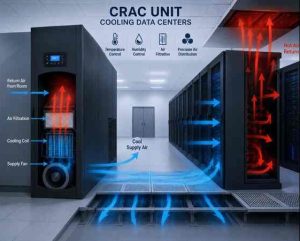
CRAC units continuously monitor and regulate:
- Temperature Control
Maintains precise cooling levels to prevent overheating of critical equipment.
- Humidity Control
Controls moisture levels to prevent static electricity and condensation issues.
- Air Filtration
Removes dust and airborne contaminants that can damage sensitive electronics.
- Air Distribution
Ensures uniform airflow throughout the facility, eliminating hot spots and improving cooling efficiency.
Types of CRAC Units
- Direct Expansion (DX) CRAC Units
DX CRAC systems use refrigerant-based cooling where heat is removed directly through a refrigeration cycle.
Advantages:
– Faster installation
– Lower initial investment
– Compact design
– Ideal for small and medium-sized facilities
Applications:
– Server rooms
– Telecom shelters
– Network operation centers
– Small data centers
- Chilled Water CRAC Units
These systems utilize chilled water supplied from a central chiller plant to provide cooling.
Advantages:
– High energy efficiency
– Suitable for large facilities
– Lower operating costs
– Scalable for future expansion
Applications:
– Enterprise data centers
– Hospitals
– Large commercial buildings
– Industrial facilities
Key Benefits of CRAC Units
1. Continuous 24/7 Operation
CRAC units are designed for round-the-clock operation, ensuring uninterrupted cooling for critical environments.
2. Precision Environmental Control
Maintains temperature and humidity within strict tolerances required by modern IT equipment.
3. Improved Equipment Reliability
Stable environmental conditions reduce equipment failures and improve operational uptime.
4. Enhanced Energy Efficiency
Modern CRAC systems feature advanced controls, EC fans, variable-speed compressors, and intelligent monitoring systems to optimize energy consumption.
5. Scalability
CRAC systems can be configured to meet the growing cooling requirements of expanding facilities.
Applications of CRAC Units
- Data Centers
Data centers depend on precision cooling to maintain server performance and prevent costly downtime.
- Server Rooms
CRAC units provide reliable cooling for business-critical IT infrastructure.
- Telecommunications Facilities
Communication networks require stable environmental conditions to ensure uninterrupted connectivity.
- Healthcare Facilities
Medical equipment and healthcare IT systems rely on precise cooling and humidity control.
- Industrial Control Rooms
Manufacturing plants use CRAC units to protect automation systems and process control equipment.
- Financial Institutions
Banks and financial organizations require continuous cooling for transaction processing and data storage systems.
Factors to Consider When Selecting a CRAC Unit
When choosing a CRAC solution, organizations should evaluate:
– Cooling capacity requirements
– Room size and heat load
– Redundancy requirements
– Energy efficiency targets
– Future expansion plans
– Environmental conditions
– Maintenance accessibility
A proper cooling assessment helps ensure the most effective and cost-efficient solution.
Maintenance of CRAC Units
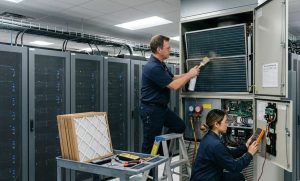
Regular maintenance is essential for achieving maximum performance and reliability. Typical maintenance activities include:
– Filter cleaning and replacement
– Refrigerant inspection
– Coil cleaning
– Fan motor inspection
– Electrical system checks
– Controller calibration
– Airflow verification
Preventive maintenance helps reduce downtime, improve efficiency, and extend equipment lifespan.
Conclusion
As data centers, server rooms, and critical facilities continue to expand, the demand for reliable precision cooling solutions is increasing. CRAC units play a vital role in maintaining optimal operating conditions, protecting valuable equipment, and ensuring uninterrupted business operations.